
Test of the day…Unusual tests and ideas to inspire you to think hard and try a few new things.
Using Beightons Score is just not enough!
Hypermobility is becoming more and more recognised and is to be taken seriously to diagnose the reason why pain is often there. Beightons score and in combination with Beightons criteria can help greatly to determine the extent of the problem.
Beightons Score is easy to carry out, and should be explained properly to the patient. This score is just not enough in itself to get a good ideas of the problems someone if having or if other parts of their health are being affected.
You should really use both the Score and the Criteria to make a good judgement call. The Beightons Criteria has been validated on over 16 year old patients, but not as yet on children. Is is alos being used often in research.
Especially look out for physical characteristics of Marfans syndrome, and connect tissue disorders.
Follow the link to the Hypermobility Association website- for some great advice for therapists and for patients.
Most hypermobility is dealt with in hospital by Rheumatology Departments, but there are some great clinics which have a special interest in Hypermobility and I have had some great success and help from help.
For adults there is a clinic at:-
University College Hospital London
National Hospital for Rheumatic diseases, Bath
Rheumatic diseases, Glasgow Royal Infirmary
For children- Sue Mailliard, Hypermobility Clinic Great Ormond Street Hospital
For more details- click here
www.hypermobility.org/clinics.php
Beightons Score
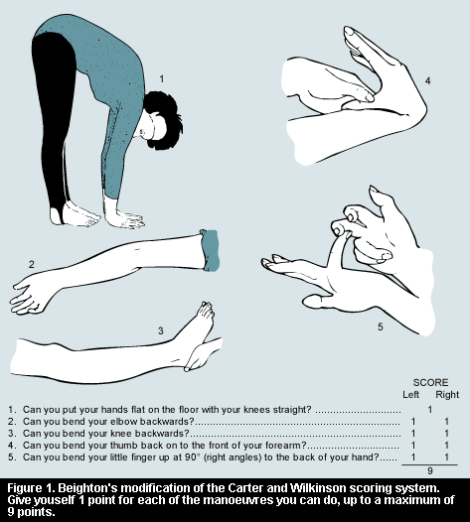 Taken from the Hypermobility website
The Beighton Criteria
The Brighton Criteria takes into account the Beighton score, but also is there to help you consider other symptoms, such as joint pain and dislocated joints, and how long the patients have had them. There are major and minor Brighton criteria.
Major criteria
The major Beighton criteria are:
- having a Beighton score of four or more, either now or in the past
- having joint pain for longer than three months in four or more joints
Minor criteria
The minor Beighton criteria are:
- having a Beighton score of one to three, or having a Beighton score of zero to three if the patient is over 50 years of age
- having joint pain for longer than three months in one to three joints, or back pain for longer than three months, or spondylosis (spinal arthritis) or spondylolisthesis
- dislocating, or partially dislocating, more than one joint or the same joint more than once
- having three or more injuries to soft tissues, such as tenosynovitis or bursitis
- having particular physical characteristics such as Marfanoid habitus
- having abnormal skin, such as thin and stretchy skin
- having eye-related symptoms, such as droopy eyelids or short sightedness having swollen and enlarged veins or a hernia, or a rectal or uterine prolapse
Joint hypermobility syndrome may be diagnosed if the patient has:
- two major criteria
- one major criteria and two minor criteria
- four minor criteria
- or if the patient has two minor criteria and a close relative, such as a parent, who has been diagnosed with joint hypermobility syndrome
Coming soon….
Hypermobility syndromes, types and help that you can give.
 physioandrehab