 On the whole I see lots of unusual things everyday, lots of unusual anatomy and weird and wonderful presentations. Accessory Plantaris is controversial in its presentation both as a structure that can be injured and whether it is there at all.
The plantaris muscle is often dismissed as a small,vestigial muscle, however an injury to this structure should actually be included in differential considerations of the painful calf. Injury to the plantaris on its own, or in association with concurrent injuries of the knee can present a diagnostic challenge.(Spina 2007)
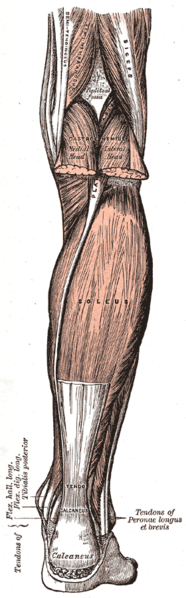
The plantaris muscle consists of a small, thin muscle belly,and a long thin tendon that forms part of the posterosuperficial compartment of the calf. Together with the gastrocnemius, and soleus, they are collectively referred to as the triceps surae muscle. The muscle originates from the lateral supracondylar line of the femur just superior and medial to the lateral head of the gastrocnemius muscle as well as from the oblique popliteal.
Palpation of the muscle belly is possible in the popliteal fossa as well as along the medial aspect of the common tendon of the triceps surae group. With the patient prone and the leg flexed to approximately 90 degrees, the distal hand of the practitioner covers the heel while the forearm is applied against the plantar aspect of the foot, allowing a simultaneous resistance to plantarflexion of the foot and flexion of the knee. The muscle is palpated in the popliteal fossa, medial and superior to the lateral head of the gastrocnemius muscle. Its tendinous portioncan be palpated along the medial aspect of the Achilles tendon into its calcaneal insertion.
Injury has been described as being caused by various etiologies including plantaris tears, medial head of gastrocnemius tears, soleus tears, or a combination thereof. The injury occurs most frequently during running or jumping and usually results from an eccentric load placed across the ankle with the knee in an extended position.
So the next time you she what you think is a tendinopthay, a gastroc tear, soleus tear or a low slung soleus, think if it could possibly be a plantaris. You can get all the same pathologies in the plantaris, but tenosynovitis is common as is tears and trigger points.
So keep an eye out for unusual anatomies making unusual pathologies… not everyone is made the same, and not everyone has a simple Achilles tendinopathy.
 physioandrehab